

 Dementia Support Line
Real stories
Finding ways to help yourself and to help others after a dementia diagnosis
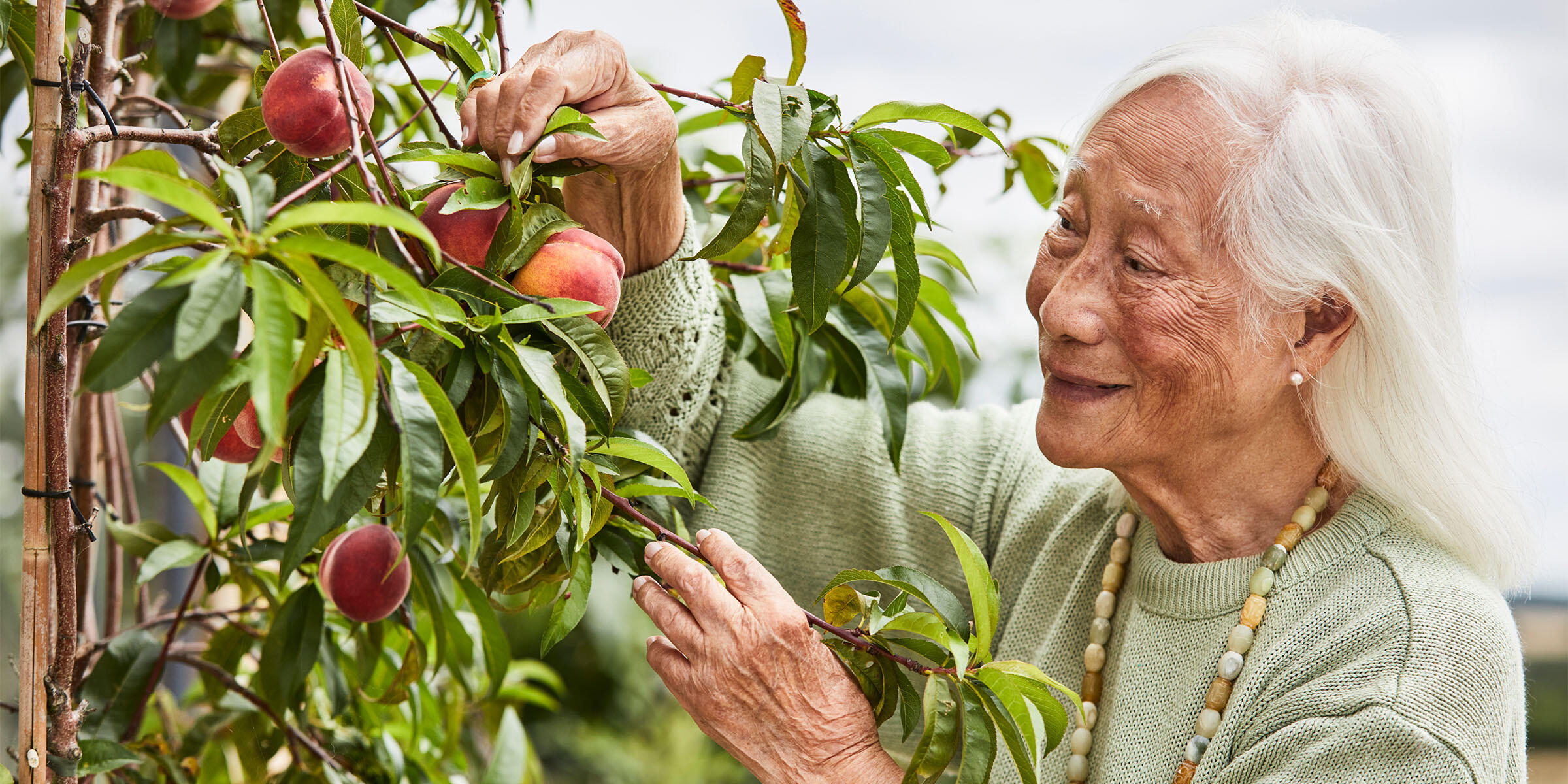
Annie Chinfen, in Essex, has had a long, eventful life and she’s still making the most of her time living with Alzheimer’s disease.
She may be 96 and living with Alzheimer’s disease, but Annie Chinfen remains clear about what she thinks is most important in life – to help yourself and to help others.
Annie learned these lessons during a long life, in a career as a nurse and time living with dementia.
She has survived a war and rioting. She was brought up with riches and had every penny taken away.
It has left her determined to make the most of life.
‘I love to learn,’ says Annie, ‘and I’m still learning now.’
A rich and traumatic childhood
Annie was born in Hong Kong before the Second World War, to a rich family who owned department stores.
They had servants, gardeners, drivers and lived in luxury. It was common for wealthy men to have multiple wives, so Annie had many stepmothers and half-siblings.
Her carefree life was cut short when suddenly, at 10, Japan invaded Hong Kong.
‘I looked out of my window saw a plane bombing the English ship in the harbour. My mother said, “Don’t go to school. We stay here.”
We couldn’t believe what was happening. It was frightening. I didn’t know about life and death, and then my half-brother’s girlfriend suddenly lost her whole family.
‘If you passed a Japanese soldier and didn’t bow, you were killed. Many others starved. People chopped down everything they could find for fuel. All English schools were shut, and a lot of English teachers and our headmistress were sent to prisoner of war camps.’
After the war, Annie and her brothers and sisters studied hard to catch up with the years they’d lost.
‘I wanted to become a doctor because I had seen so much death. My dad believed girls should stay at home and marry someone rich. He said, “No.”
‘So I said, “Can I be a nurse?”. He said that was a dirty job and he wouldn’t talk to me, but my mum supported the idea and I went ahead. He was angry but eventually was proud of me. My parents both attended my graduation.’
Becoming a nurse and trainer
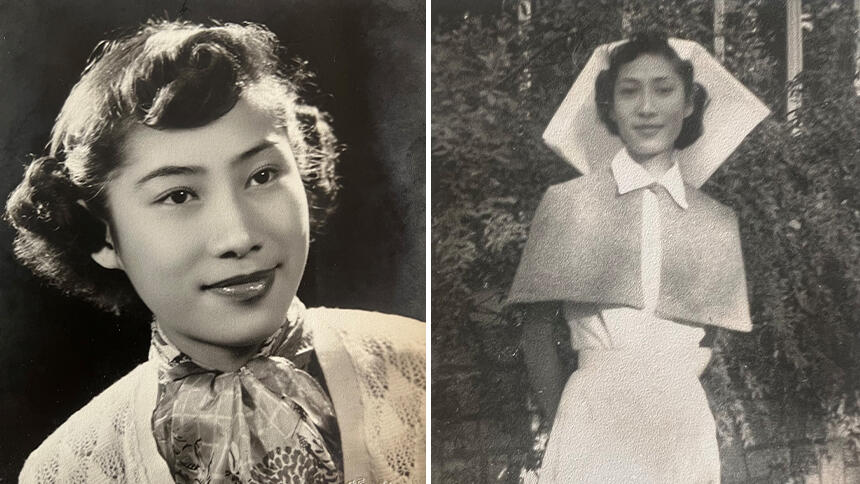
Annie became a state registered nurse, passing general nursing and midwifery at the top of her class.
She was promoted quickly and became a sister, and a lecturer training other nurses.
‘I learnt every minute. I watched the patients and saw when they recovered and when they died.
‘I saw people refusing to get out of bed, even to sit in a chair.
'They thought, “You nurses must do everything, feed me, wash me. I’m not moving.” I think that attitude shortened their lives, without them realising.
‘I’m the opposite. I believe you must take care of yourself. Then you can get better – and take care of others too.
When I trained nurses, I always told them that you treat the patient like your own children, parents or friends.
Annie’s next move was to train nurses for the opening of Queen Elizabeth Hospital, one of the biggest in East Asia at that time. She was proud.
When Annie’s father died, she found he had entrusted all his money and property to two of Annie’s half-brothers and told them to care for the others. They announced they were going to use the money for themselves and moved everyone out of the family home.
Her mother had a heart attack nine months after her father’s death. As she lay dying, Annie’s mother asked her to look after her two younger brothers. Of course, she agreed.
Starting her own family
One day, Annie was introduced to Lloyd, a friend’s brother, while waiting at a bus stop. Lloyd called her ‘Bus Stop Girl’ and knew instantly he wanted to marry her.
Annie told him she had to bring up her brothers. After this, she found she had a severe spine condition.
She didn’t want to take advantage of Lloyd’s kindness and said he needed to wait until her condition had improved.
Then there were riots in Hong Kong. ‘I told him I’m not a selfish person who will leave injured people here suffering.’
Finally, she agreed to marry him and move to England to be with him.
She was 37 by this time, and women usually gave birth much younger in those days. But at 41 she was thrilled to have her daughter, Rachel.
‘I was so happy. My husband had a good job and he said I should give up work and became a full-time mother.
‘I felt sorry for Rachel because I couldn’t produce any more children, so I had an open house every Thursday afternoon, a tea party – any parent or child was welcome.’
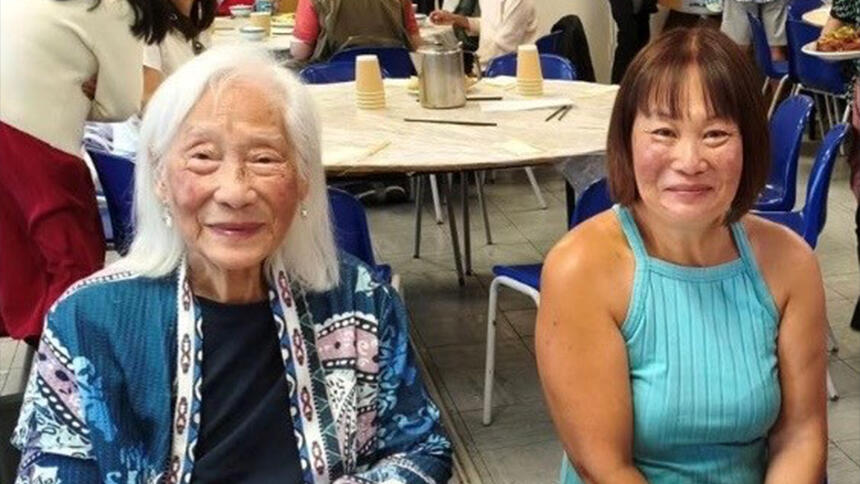
Annie with Rachel at a community centre event.
Loss and a dementia diagnosis
After 50 years of marriage, Annie’s husband died before the Covid pandemic.
‘I miss him very much,’ she says. ‘He loved classical music. I still listen and pretend he’s by my side.’
She was facing other bad news too. After a bout of cancer, Annie had a brain scan to see if it had spread. It was then she found out, nine years ago, that she had Alzheimer’s disease.
‘I was shocked. I had been forgetting things, but I thought it was just old age.
‘I wondered how I would know how to look after myself. Then I thought, there’s no need to be frightened. I started to research everything and try to understand it.
I asked how I could help myself and use my knowledge to manage it.
Annie was helped by Alzheimer’s Society when her specialist introduced her to Singing for the Brain.
‘It’s so good. It means every week I have an activity and see people. I can’t remember most of the words of the songs, but they give you the words on a sheet so I can sing along.
‘When we finish, we sit together and other people know I’m a nurse and ask me questions. I always tell them what I know.’
Staying active with dementia
Later Alzheimer’s Society asked Annie if she could help student doctors and nurses learn about the realities of living with dementia through the Time for Dementia programme.
‘I talk about my experiences and how I deal with Alzheimer’s myself. I tell them that I keep the brain as active as possible.
‘I read every day, any book I like, especially if it’s a storybook. With books, you try to imagine what the person is writing about. If you watch television your brain isn’t forced to work in the same way.
‘I tell them I keep a diary by my side and write anything I want to remember. My short-term memory is bad. I live with my daughter, and she says where she’s going, and the next minute I say, “Where are you going?” That’s why I write everything down.’
Annie has found regular exercise to be important too.
‘Before I get up and dressed, I lie flat and exercise. I use my hands to massage my scalp, head, neck, round my eyes, my shoulders, arms – my whole body. Then I sit up and do more exercises.
Looking ahead with dementia
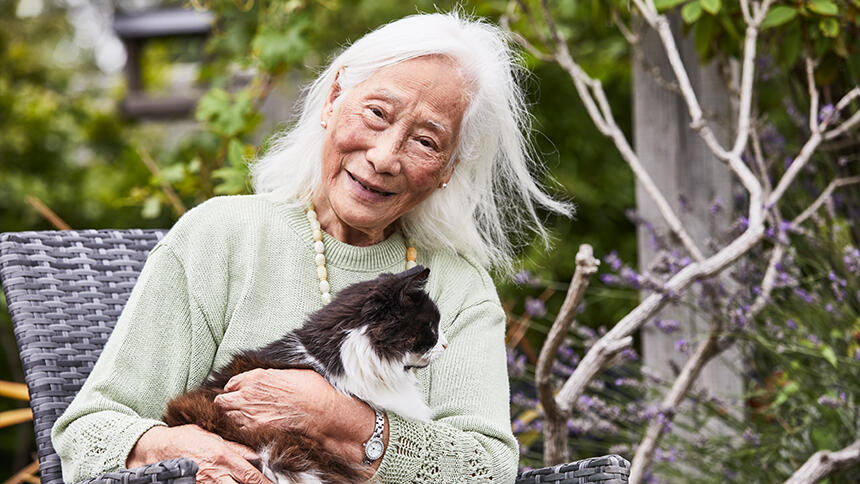
Annie, who now lives with her daughter in Essex, worries about her mobility failing her, following a recent bad fall. She has other fears too.
‘Deep down, I do worry that one day I won’t recognise my dearest ones. I don’t feel independent, but I still do as much as I can for myself,’ she adds.
‘I comb my hair and put my earrings in to make myself look nice, even if it takes me an hour.’
She also has advice for anyone communicating with a person who has dementia.
‘I’ve noticed that if Rachel is talking to a friend, I can’t follow the conversation.
I need a clear voice talking to me, someone sitting down with me at the same level with eye-to-eye contact.
Annie loves sharing her experiences and her knowledge.
‘If I can help at any time, I always want to do that.
‘I have had an unusual life, and a long-living one,’ she says. ‘I’m still making the most of the time I’m here.
‘That’s the best we can all do.’
How you can help
Your donation helps us to support more people like Annie to remain as independent as possible.