

 Dementia Support Line
Information
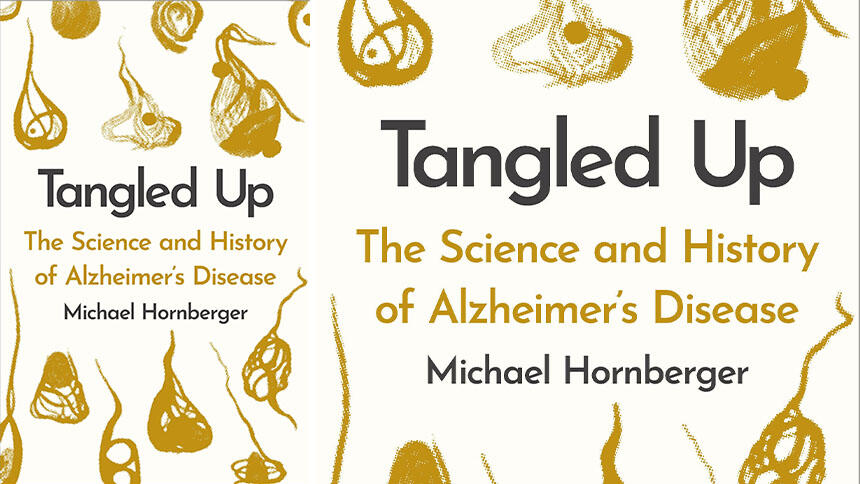
Book group: Tangled Up by Michael Hornberger
We read a ‘whistle-stop tour’ of Alzheimer’s disease, written by a neuroscientist, from its origins and diagnosis to reducing risk.
In Tangled Up, neuroscientist Professor Michael Hornberger takes an expansive approach. One he hopes will leave us feeling better informed about Alzheimer’s disease and less afraid.
He opens his book by travelling back in time to the pioneering work of early researchers. He goes on to explore how Alzheimer’s disease changes the brain, rare types of the disease, genetics, risk factors and new research breakthroughs.
All in all, it’s a comprehensive overview, says our reviewer, Harry, in Cheshire.
This is an excellent instruction manual about the inner workings of a brain affected by Alzheimer’s.
It's clear and accessible
Michael sets out to make the neuroscience of Alzheimer’s more understandable, and he largely achieves this, says Harry.
‘He comes across as someone with a deep understanding of Alzheimer’s, with the added ability to explain a technical subject in no-nonsense terms.’
The formatting of the book helps simplify the information, adds reviewer Dunroamin.
‘The book is presented well, with a firm and logical prologue citing aims and objectives.
‘It’s easy to read initially and reassuring for those with no prior knowledge. Chapters are short, with extremely helpful summaries for the different parts of the book.’
SeaSwallow agrees, ‘One thing that I found particularly useful was the way that the author provided a summary of what had been discussed at the end of each part.’
Historical insights into Alzheimer's disease
All our reviewers found the history of Alzheimer’s research incredibly thought-provoking.
‘I particularly enjoyed the narrative style describing the work of Dr Alois Alzheimer and Dr Oskar Fischer in the 1900s,’ says Jane from Kendal.
‘It’s fascinating that these men found out so much information about changes in the brain of Alzheimer’s patients, but it was not until the 1970s that work into Alzheimer’s research was reinvigorated.’
Dunroamin, who is living with Alzheimer’s, agrees.
‘I had never heard of Oskar Fischer prior to reading this book, and like all areas of science, I admired the communication and connections between the original researchers.’
Moving from the past to the future
As the book progresses, it shifts from the past to promising current and future research, looking at the potential for better diagnosis and treatment of Alzheimer’s disease.
Jane found the section on early diagnosis fascinating.
If only more attention was given to diagnosing the disease before the damage to the brain was done, the lives of those diagnosed could be improved and prolonged.
Harry was captivated by the discussion about genetic risk and the risk factors we can and can’t control.
‘One of the interesting facts revealed in this book was that the lack of formal education could affect the likelihood of being diagnosed with Alzheimer’s. Because this appears to be an obscure connection, Michael does explain in good detail why this is a factor.’
Reviewer John found the information on genetic links interesting for personal reasons.
‘My mother, aunt and grandmother all developed Alzheimer’s around the age of 65 years. I am currently 81 and showing no obvious signs of Alzheimer’s, despite having atrial fibrillation and a stroke. I remain fit and able to play tennis and badminton.’

Learning more about this cruel disease
Although our reviewers were intrigued by the exploration of ‘non-modifiable’ and ‘modifiable’ risk factors, it also raised concerns for Jane, who is carer for a person with early-onset dementia.
‘It states that by focusing on the top four risk factors for Alzheimer’s disease – obesity, getting enough exercise, eating a Mediterranean diet and getting enough sleep – the risk of developing Alzheimer’s disease could be reduced by 40%.
‘But I was left thinking if only it were that simple! I wouldn’t want people reading this book to think they were responsible for getting this cruel disease.’
Despite the author’s best efforts to keep things simple, our reviewers were also left confused by some technicalities.
‘I found the references to figures and various graphs, out of context, very confusing,’ comments John.
Some chapters left Harry scratching his head.
‘Although to give Michael his due, he did explain things in easy terms.’
SeaSwallow agrees it’s complicated in places and sometimes repetitive, but says they still learned plenty.
‘By the very nature of the book, it is quite technical at times, which I did on occasions find difficult to follow.
‘However, I did learn more about the nature of Alzheimer’s disease, the changes within the brains of people affected and why it will be so difficult to find a cure.’
Getting insight and understanding
Tangled Up is for people who want to improve their understanding of Alzheimer’s, and it’s probably more enlightening and stimulating than comforting.
‘The book would be useful for people interested in the rare forms of Alzheimer’s,’ adds SeaSwallow.
If you’re currently affected by dementia, it’s difficult for our reviewers to say whether you’d enjoy it. It comes down to you and your individual circumstances.
It could leave you feeling frustrated that you won’t benefit now from future progress. But there are other aspects that could be helpful.
‘For those families struggling to obtain a diagnosis, there is an extremely helpful paragraph that illustrates why diagnosis can be complex and prolonged,’ says Dunroamin.
‘For anyone caring for someone with Alzheimer’s, this book will ring many bells and provides insight into why patients do the things they do,’ adds Harry.
Tangled Up by Michael Hornberger (Canbury, 2025), 252 pages, £22.00, ISBN: 9781914487422. Also available as an ebook.