

 Dementia Support Line
Real stories
People affected by dementia find connection and support through our Companionship service
Dealing with dementia can be lonely, so our Companionship service offers comfort and company to people with the condition and their families.
‘Loneliness eats away at you. You have to have someone,’ says Jim at his weekly online group chat.
Norman, who keeps the group smiling with his cheeky humour and songs, explains:
It’s friendship. That’s what companionship is.
Norman admits that life after a dementia diagnosis can be ‘a very difficult path to walk’.
The online meetup, launched in January 2026, aims to make that walk a little easier by connecting people who share the same experiences.
It is part of the Society’s Companionship service, which reduces isolation and provides reassurance for people with dementia and their carers.
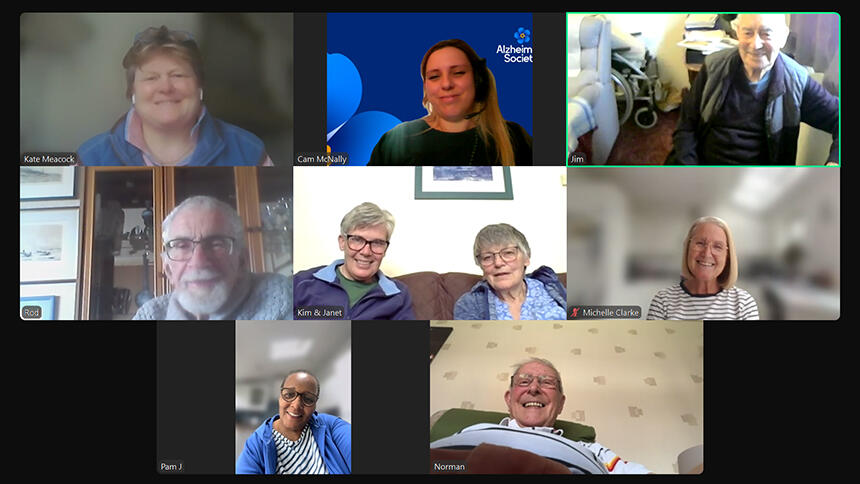
An online meetup
Phone calls and online groups
The Companionship service began during the pandemic with a volunteer-led telephone service.
Designed to be a temporary stopgap, it was such a hit that it’s still offering the chance to talk about all kinds of things.
‘People say it is nice to talk to someone outside the family about something other than dementia’, says Sam Watson, a Companionship volunteer officer.
And they appreciate that someone is checking in on them every week.
Cam McNally, a team leader, explains, ‘We decided to go online at the beginning of this year because people wanted that face-to-face contact, and to chat to people experiencing the same things.
‘And we can direct them to the online forum where they can get information and support.’
Volunteering for Companionship
Assunta Hammick began getting calls from the service two years ago after her husband John’s diagnosis.
‘The lady who called had cared for her mother and father-in-law,’ says Assunta in Milton Keynes.
‘So I felt I had someone who had been there too.’
Sadly, Assunta’s husband died in March, but she plans to train as a volunteer caller.
‘I want to give back. The NHS trains doctors and nurses in the medical stuff, but it is just as important to talk to people about the practical side of caring.’
Norman Blackmore started using the service after his wife Margaret was diagnosed with Alzheimer’s disease seven years ago.
‘The calls mean something to me because I no longer have chitchat with Margaret and they stop me feeling so isolated,’ says Norman, from Cardiff. ‘And the online group is brilliant.
Everyone is so lovely, and it is great to see everyone. We talk about everything and I have even been known to give them a song or two!
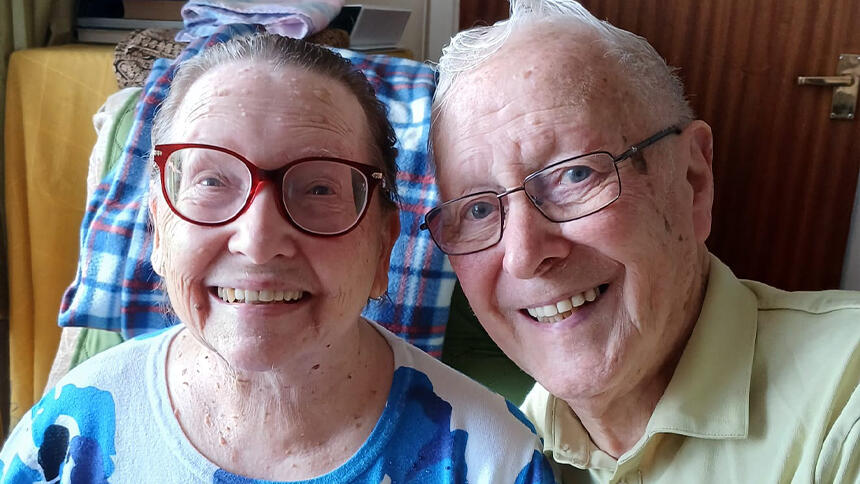
Margaret and Norman
Companionship reduces isolation
The service has 438 trained volunteers supporting 722 people in England, Wales and Northern Ireland.
The volunteers befriend rather than give advice, though they can refer to a dementia adviser.
Volunteer Zeinab Awadalla, from east London, was inspired to join by her grandparents who had dementia. And she gets as much from the calls as the users.
‘If you are an empathetic person, it feels good to help others.
People tell me I’ve lightened their day and sometimes I’m the only person they’ve spoken to all week.
Volunteers inspire action
Sharon Barnes in West Yorkshire, who has Alzheimer’s disease, is one of the people called by Zeinab every week. She says she doesn’t know what she’d do without her.
‘She’s absolutely gorgeous,’ says Sharon. ‘I don’t get out much now and I’m pretty lonely, but Zeinab puts my mind at ease and she’d make a great best friend!’
As well as relieving people’s loneliness, Zeinab is proud to have inspired her telephone companions to pick up hobbies again and go out more.
She explains, ‘When people say I have motivated them to go out, it makes me feel good.’
Cam says the service not only provides company but helps people stay independent longer by signposting support.
And Sam adds, ‘Even though the volunteers don’t give advice, just having that conversation with someone outside your family can help you feel lighter.’
Companionship service
Our Companionship service connects people affected by dementia with friendly volunteers for regular, supportive conversations.