
 Dementia Support Line
Real stories
‘I’d never imagined this would be possible’ – dealing with the realities of life after a dementia diagnosis
Dave Gater, in Northamptonshire, shares his thoughts about life before his dementia symptoms, before diagnosis and since.
Looking back, Dave sees now that he was bottling things up at first after his Alzheimer’s disease diagnosis – something that led to a mental health crisis.
Since then, he’s found ways to be active and involved while dealing with the realities of how his life has changed.
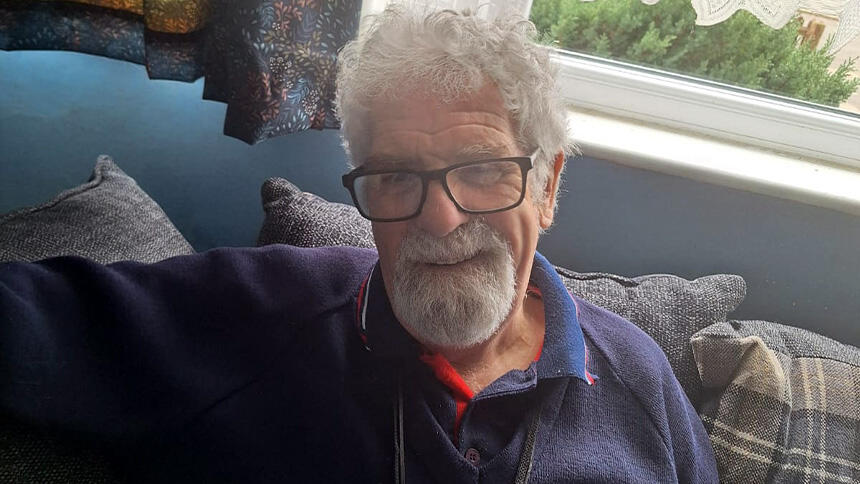
Before Dave developed dementia symptoms
Up to retirement, I spent 15 years in security, working across building sites, hotels and supermarkets. Before that I worked in food retail.
I was born in London and so was my wife Dianne. We married 55 years ago, when we were both 18.
We didn’t fancy living in a high-rise flat, so we moved to Peterborough, where they were building new houses. We have three grown-up daughters, nine grandchildren and seven great-grandchildren.
I didn’t grow up in a religious house, but my faith became one of the pillars of my life.
One of my other enduring passions is football. When I was 13, I was at the 1966 World Cup final. True to my London roots, I’m still a big Chelsea fan.
I have long-standing health problems due to having dextrocardia, where my heart is on the wrong side of my body, but I’ve always been physically fit. I love gardening, and I’m into trains and the history of railways in a big way.
Before Dave’s dementia diagnosis
Life was busy. As well as working, I was a councillor on a small council in a neighbouring village. I noticed I was becoming forgetful and unable to concentrate where I was working. I left stuff unlocked and the entry barrier up!
When I was 68, I thought, ‘I can’t do this any more,’ and I retired.
A few months after retiring, during the Covid pandemic, I went to my GP about my concerns. My mum and my mother-in-law developed dementia, so I’d seen it first-hand.
After some diagnostic tests, I was told I had Alzheimer’s disease. Then I was just left to my own devices. I understand there were pandemic restrictions, but there was no follow-up and no support offered.
I decided I wasn’t going to sit and wallow.
My eldest daughter, who was a nursing assistant at the time, said to Dianne, ‘He’s coping too well.’ She thought bottling things up could lead to a breakdown, because she’d seen it before.
She was right, things came to a head and I went to a dark place. I ended up being sectioned and spending time on a mental health ward.
Since Dave’s dementia diagnosis
Finding Alzheimer’s Society and getting involved in various projects, including the reader panel, keeps me feeling upbeat.
I’ve also been involved with academic work, including a creative writing project at the University of Surrey. That’s been fabulous – we produced a book and I’ve got several stories in it.
I’d never imagined this would be possible. I have dyslexia and, at school, the teachers gave up on me so I gave up on studying. I wasn’t diagnosed with dyslexia until my 40s.
I’m in a bit of a limbo with my dementia diagnosis, as I’ve been told it might be mild cognitive impairment.
This is a difficult situation, but it is what it is. Many people have frustrating diagnosis experiences. I don’t believe enough is being done by the government to fund the care we need.
I’ve still got my faith, my gardening and my love of trains. I’ve also been involved with fundraising for Alzheimer's Society at a local club. It was an amazing team effort, led by the club secretary, and we raised over £1,800. I’d love to get involved in more fundraising.
Staying active and involved is so important. I’d encourage others to do the same if they’re able, because you get a lot out of it. But don’t put pressure on yourself.
Share your experiences
Do you want to share your experiences of life before and after your dementia diagnosis? Email the Dementia together magazine to find out more.