

 Dementia Support Line
Real stories
Still performing and teaching music after a dementia diagnosis
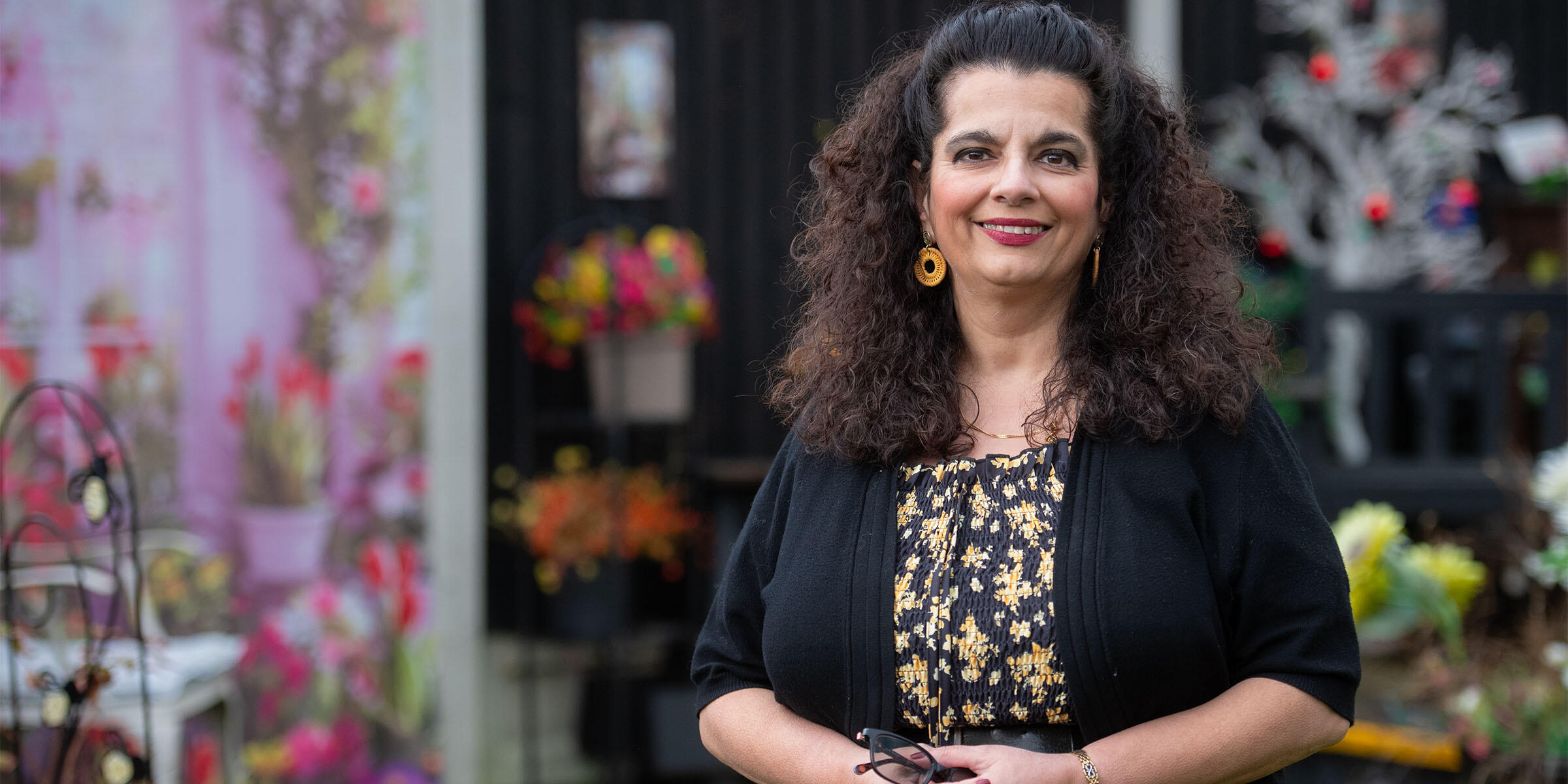
Lorena, from Essex, is grateful that her dementia hasn’t affected her ability to share her enjoyment, knowledge and love of music.
Since she was young, music has played a vital part of Lorena’s life. Now at 60, and with young-onset dementia, this hasn’t altered at all.
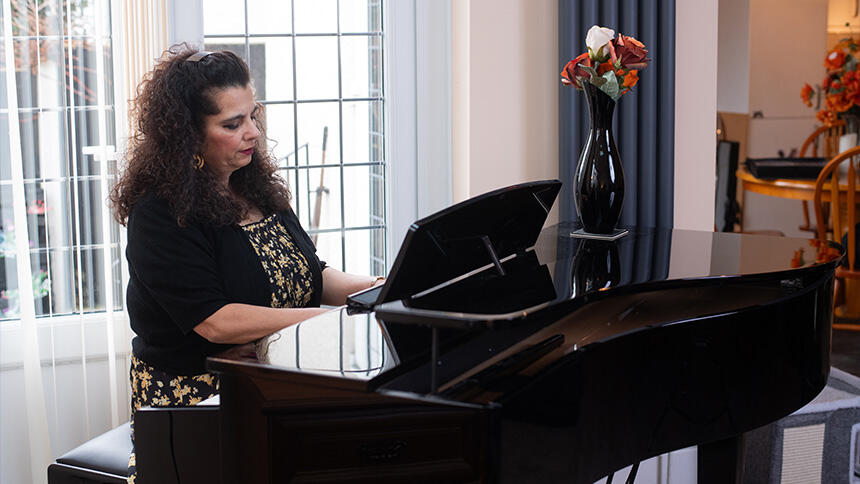
A grand piano takes pride of place in her light, airy living room. This is where her musician friends come over for soirées. Her partner of 40 years, Bryan, is also a pianist.
‘Many of them are reputed musicians,’ Lorena adds, ‘there is a local artisan pub that employs all the best players.
I teach every evening so, when finished, I go and listen to them playing. This comprises much of my social life.
‘We all have a great time together and share a close bond.’
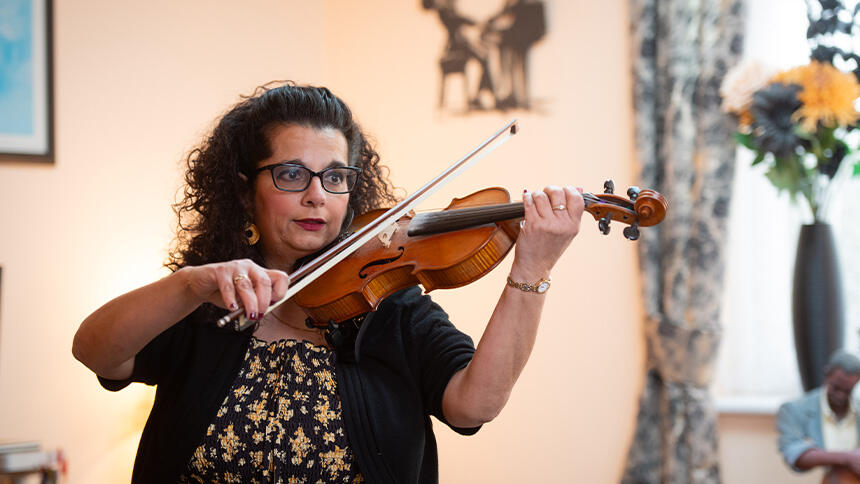
Lorena has a purpose-built music room where she teaches 35 students piano, violin and music to degree standard. She also plays in hotels and restaurants.
‘I shy away from being watched as a solo performer,’ she says, ‘but I don’t mind sitting behind a piano in a hotel or restaurant. Or in a church when employed for weddings and funerals on organ.’
Being born into music
Lorena is relieved that dementia hasn’t dented her appreciation or knowledge of music. She is also grateful to her music-loving parents for giving her the best start in life.
‘Dad, being Italian, loved classical music, and Mum had a good ear. We used to play duets together. My parents weren’t professional musicians but they encouraged me all the way.’ she says.
‘I had my first piano lesson aged six. I was very fortunate that my teacher was unsighted. He trained me to rely on my ears.
‘Although he couldn’t see, he used to spookily realise errors – “Lorena, your third finger is on G, put your fourth finger on it.” I owe my highly attuned “ear” to him, alongside innate ability.’
Lorena gained her first degree at the Royal College of Music, followed by Goldsmith’s College, University of London.
She spent 21 years as head of music in secondary schools, semi-retiring to start her own business – Bluebell Music Academy – teaching instruments, including accredited exams, theory, GCSEs, A levels and helping with dissertations for degrees.
Experiencing memory problems
Lorena’s memory problems started when she was a child.
‘I had meningitis and was in a coma for a short while. I emerged from it with slight damage to one of the temporal lobes in the memory area of my brain.
‘I’ve always had a bad memory and used to get reprimanded at school for not concentrating. However, I did well in my O and A levels.
‘It is now at a stage where my brain completely deletes information. I cannot recall where and when I went on holiday and even who I was with.’
Lorena relies on careful notes to keep track of her students, especially since many of them have unfamiliar names from a range of cultures.
My memory is such that until they arrive, I sometimes do not know if I will be teaching a boy or girl.
‘Sadly, this is the nature of my Alzheimer’s disease, but I do keep copious notes pertaining to each lesson.’
Receiving a diagnosis
Four years ago, Lorena was referred to a consultant neurologist in London. He identified problems with her temporal lobes and she was diagnosed young-onset dementia.
He then retired, leaving Lorena without help or a formal acknowledgement of her diagnosis.
‘He had no successor, so I personally had to request, even plead, for a referral for an MRI from the GP.’
Finally, she was given an MRI scan. She then received a short text message formalising a temporal lobe Alzheimer’s diagnosis.
‘I wasn’t satisfied with the text,’ says Lorena, ‘so I returned to the doctor requesting a formal letter. I finally got this three years later.’
There was no follow-up after the letter – she was told the neurologist had done his job. However, she had the diagnosis in writing now.
‘I knew I had Alzheimer’s disease,’ she says. ‘There was even slight relief that there was a reason for my very poor brain function. I knew it was too weak to be a result of the menopause or natural ageing.’
Using lists and writing memoirs
Lorena says the only help she has received since diagnosis is from Alzheimer’s Society, and she is grateful for this.
‘Luckily, I do not have depression. But I do have a little cry when I have put my foot in it yet again.
I am frustrated and embarrassed when I have not recalled something important and am becoming increasingly solitary through choice. Alzheimer’s has made me feel safer and happier on my own.
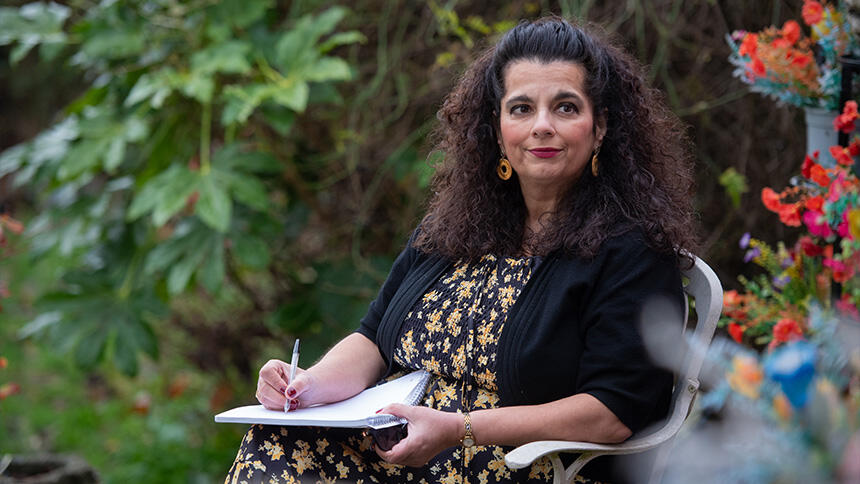
‘I rely totally on lists and write everything down, all colour coded. Things I must do are in red pen, conversations in green and my pupils are in black.
'If I were ever to lose my diary or my phone, I wouldn’t have a clue about, well… everything. I am a good writer and my organisation keeps me intact.
Lorena monitors herself through her diaries and writing. For instance, she has recently discovered that it can take her longer now to find a word she’s searching for. She’s writing her memoirs too, a journal of good and bad days.
Lorena's circles of friends
Some people in Lorena’s life have not accepted her dementia diagnosis.
‘I don’t think those close to me believe it, because I’ve always had such a bad memory. Nevertheless, my sister is my lifeline.
‘She’s very good at reminding me what not to say. For example, “Don’t say it’s nice to meet you, because you’ve met him twice already.”‘
Lorena now finds it hard to socialise with people who talk about past events.
‘I can’t join in because I have no recollection at all, so I can come across as being moody, just sitting there quietly.’
She finds it easier with her musician friends, since they largely speak in the present together.
Her 60th birthday party was a cheery event. She’s proud that she organised this herself, for 100 guests. The partygoers included members of the Alzheimer’s Society group she has joined.
‘The group talks every Friday on Zoom and have become good friends. I am close to one lady in particular; she has also been a professional. They are all lovely people, very knowledgeable and ready to share advice.
‘I seem to be the worst “memory-wise” of them all. They say, “How did you get on last week?” I scurry to get my diary out.’
She even helps one member of the group with her piano learning.
The ups and downs of living with dementia
Lorena loves Italy, and has been on holiday alone there three times, though this has had its difficulties.
‘I get very lost. Last time I stayed in a villa at the foot of a mountain. There was a concert in the piazza one evening and I was dressed up, complete with high heels. Afterwards I could not find my way back, despite my reminder photographs.
'I went up one way, then down another. It took from 12am to five in the morning to find my abode. I was so very frustrated and upset. I was dirty and my feet hurt.'
Back in the UK, she takes every Friday off and travels outside of her hometown to meet friends, see a show, musical, dance, art galleries or something else cultural. She loves London and enjoys a walk in the woods or countryside drive.
She says she doesn’t know enough about dementia to give advice to others, though she is happy to share her personal experience.
I live for today and ensure I do everything I want to do and enjoy. This is all one can do to accept and stay content in the circumstances.
I think I’m still fresh to acceptance, since it wasn’t too long ago that I received the text. But if somebody joined our group and they were new to their diagnosis, I’d probably befriend and invite them to ring me anytime.'
How you can help
Your donation helps us to support more people like Lorena to remain as independent as possible.